
 While many of the report’s recommendations covered the need to harmonise policies and cross-border standards, Tay also weighed in on what digital players could do, and had been doing, to overcome the challenges of building a green economy in the region.
In the area of data infrastructure, Tay recognised that many digital giants – like Google, Equinix and Microsoft – had taken the lead to green their data centres. But asking the question – “Are the data centres in our region equally efficient?” – he urged them to go further beyond Singapore to apply a more uniform green approach across the region.
Then cautioning that there was going to be a limit to energy efficiency, he said: “Energy efficiency means being able to do more with the same or less, but we still are going to use carbon.” To offset their emissions, he advised companies to find verifiable real carbon credits in nature-based solutions, such as planting trees and conserving and restoring mangroves.
Moving on, Tay proposed that renewable energy efforts – in solar, wind or hydro-power – should also extend across borders. According to the report, an ASEAN power grid will see renewable energy-rich countries export their surplus power to other countries and reduce the entire region’s reliance on fossil fuels. However, a lack of good-quality data is currently hindering the development of green finance, which is a critical enabler of this goal.
Nonetheless, Tay cited notable efforts by some companies to provide ‘green fintech’ funding, like the Stripe Climate service from payments company, Stripe, for customers to donate a fraction of their revenues from payments to support emerging carbon removal technologies. He also mentioned IBM’s platform, created in partnership with RaiseGreen, for individuals to invest in clean energy projects and hoped that such niche efforts could be scaled up and grown to provide more support for green innovations.
Next, Tay touched on sustainable digital trade and pushed for companies that put their products on platforms to consider their Scope 3 emissions, or the indirect emissions generated in their supply chains. As huge volumes of paperwork were still needed to move goods across borders, these suppliers would need to digitise their supply chains to improve their material management, reduce costs and track their Scope 3 emissions.
“Rather than see it as a constraint, we can see it is an opportunity for digital transformation to create more efficiency,” he said.
Public-Private Partnerships
According to the report, “to get to a green economy, there are many changes that are needed in economic and social activity, especially linked to the sources of power for factories, households, transportation, and supply chains.”
While many of the report’s recommendations covered the need to harmonise policies and cross-border standards, Tay also weighed in on what digital players could do, and had been doing, to overcome the challenges of building a green economy in the region.
In the area of data infrastructure, Tay recognised that many digital giants – like Google, Equinix and Microsoft – had taken the lead to green their data centres. But asking the question – “Are the data centres in our region equally efficient?” – he urged them to go further beyond Singapore to apply a more uniform green approach across the region.
Then cautioning that there was going to be a limit to energy efficiency, he said: “Energy efficiency means being able to do more with the same or less, but we still are going to use carbon.” To offset their emissions, he advised companies to find verifiable real carbon credits in nature-based solutions, such as planting trees and conserving and restoring mangroves.
Moving on, Tay proposed that renewable energy efforts – in solar, wind or hydro-power – should also extend across borders. According to the report, an ASEAN power grid will see renewable energy-rich countries export their surplus power to other countries and reduce the entire region’s reliance on fossil fuels. However, a lack of good-quality data is currently hindering the development of green finance, which is a critical enabler of this goal.
Nonetheless, Tay cited notable efforts by some companies to provide ‘green fintech’ funding, like the Stripe Climate service from payments company, Stripe, for customers to donate a fraction of their revenues from payments to support emerging carbon removal technologies. He also mentioned IBM’s platform, created in partnership with RaiseGreen, for individuals to invest in clean energy projects and hoped that such niche efforts could be scaled up and grown to provide more support for green innovations.
Next, Tay touched on sustainable digital trade and pushed for companies that put their products on platforms to consider their Scope 3 emissions, or the indirect emissions generated in their supply chains. As huge volumes of paperwork were still needed to move goods across borders, these suppliers would need to digitise their supply chains to improve their material management, reduce costs and track their Scope 3 emissions.
“Rather than see it as a constraint, we can see it is an opportunity for digital transformation to create more efficiency,” he said.
Public-Private Partnerships
According to the report, “to get to a green economy, there are many changes that are needed in economic and social activity, especially linked to the sources of power for factories, households, transportation, and supply chains.”
 Tay recognised that no single digital player could, ultimately, overcome these challenges alone. But the digital sector as a whole could work in tandem with the governments to green the standards and other means of powering the economy.
The report concludes that while governments take the lead in regulatory standards, policy frameworks and regional cooperation, among other things, the public-private sector collaboration is also fundamental to the development of the digital-green economy, especially in the aspects of innovation and inclusion.
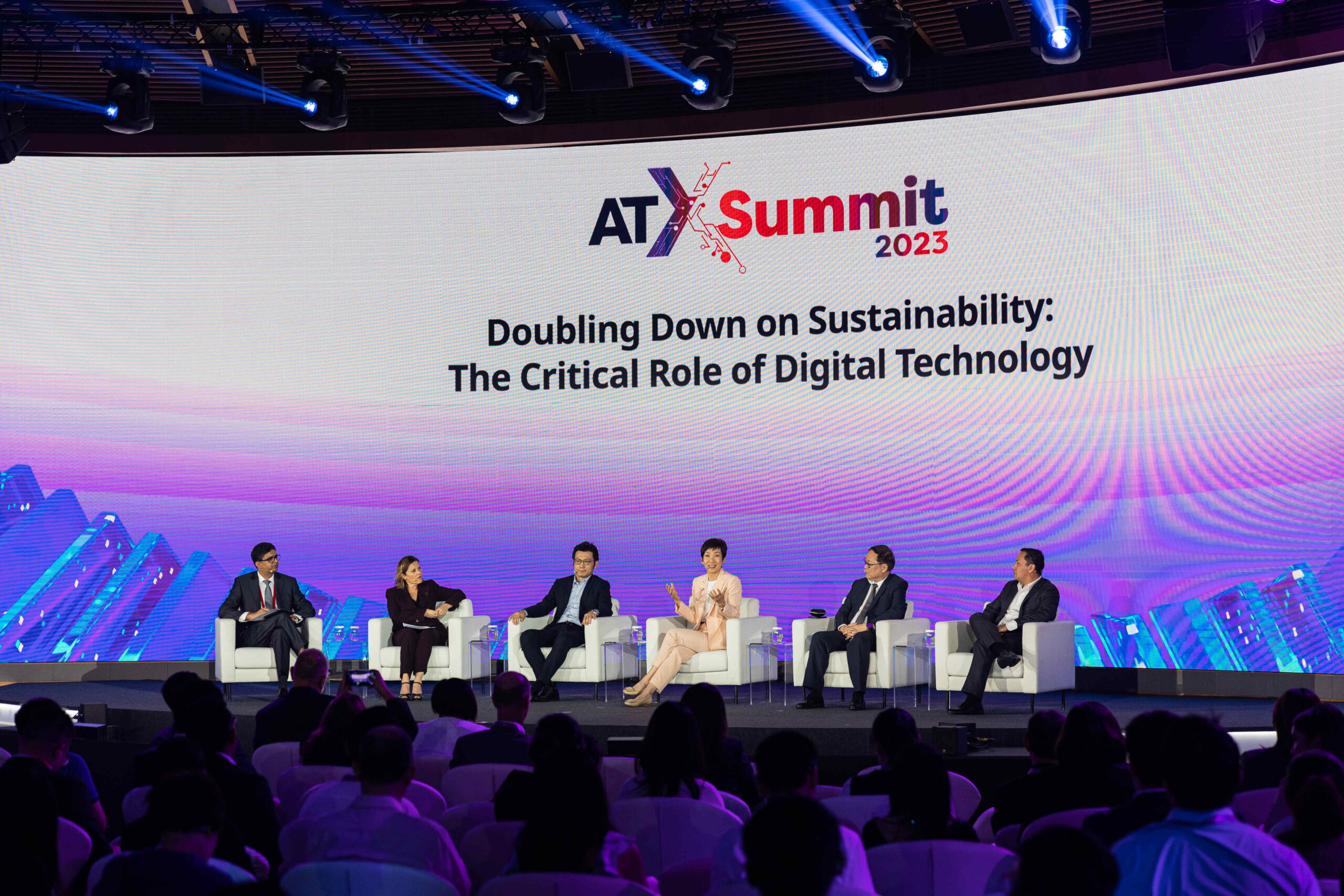
The theme of public-private partnerships was also echoed at the ATxSummit plenary session ‘Doubling Down on Sustainability: The Critical Role of Digital Technology’. At the session, Grace Fu, Minister for Sustainability and Environment joined other distinguished panellists to discuss strategies for a greener future.
Resilient Future
Minister Fu said that one of the horizontal enablers of the Singapore’s Green Plan 2030 was the involvement of businesses and the community. She encouraged business leaders to take the Green Nation Pledge to commit to climate action.
To build a resilient future, Minister Fu said that digital technology would have a tremendous impact on how people understood future weather patterns to “produce more with less resources” in the context of climate change.
“In order for us to have better adaption, we need better modelling, to forecast the impact of climate on everything that we do … from food production, to logistics movements, to aviation,” she said.
The ‘Building a Digital-Green ASEAN’ special report by the Singapore Institute of International Affairs was made possible by key sponsors Infocomm Media Development Authority, Equinix and Huawei, and sponsors Microsoft and Tata Consultancy Services. The full report can be downloaded here.
Lynette Hooi is a freelance writer
Tay recognised that no single digital player could, ultimately, overcome these challenges alone. But the digital sector as a whole could work in tandem with the governments to green the standards and other means of powering the economy.
The report concludes that while governments take the lead in regulatory standards, policy frameworks and regional cooperation, among other things, the public-private sector collaboration is also fundamental to the development of the digital-green economy, especially in the aspects of innovation and inclusion.
The theme of public-private partnerships was also echoed at the ATxSummit plenary session ‘Doubling Down on Sustainability: The Critical Role of Digital Technology’. At the session, Grace Fu, Minister for Sustainability and Environment joined other distinguished panellists to discuss strategies for a greener future.
Resilient Future
Minister Fu said that one of the horizontal enablers of the Singapore’s Green Plan 2030 was the involvement of businesses and the community. She encouraged business leaders to take the Green Nation Pledge to commit to climate action.
To build a resilient future, Minister Fu said that digital technology would have a tremendous impact on how people understood future weather patterns to “produce more with less resources” in the context of climate change.
“In order for us to have better adaption, we need better modelling, to forecast the impact of climate on everything that we do … from food production, to logistics movements, to aviation,” she said.
The ‘Building a Digital-Green ASEAN’ special report by the Singapore Institute of International Affairs was made possible by key sponsors Infocomm Media Development Authority, Equinix and Huawei, and sponsors Microsoft and Tata Consultancy Services. The full report can be downloaded here.
Lynette Hooi is a freelance writer 
Tell us about your thoughtsWrite message